17 June 2013

We'll Always Have Paris

We had emptied the refrigerator, packed our bags, hugged all our friends, said our good-byes. I had announced to my blog readers that I was taking a hiatus. We were more than ready to get on the plane to Paris, grab a car and drive south in the direction of Provence. You see, before we’d ever met each other, Mark and I had separately had intense relationships with France. I had spent years helping defend France’s honor against Amoco in the legal aftermath of the AMOCO CADIZ oil spill disaster. Mark worked in Paris for a French publisher. We were determined to see if France was still France, and if there was anything for us there anymore.

Then the French air traffic controllers went on strike to protest EU plans to create a single, unified European air space. Our Tuesday late evening flight was canceled, but, given the option between full refund and rescheduling for Sunday, we took Sunday. Actually, we got off easy. We had not been on our way to a congress or a seminar that was not going to wait for us. We were not on our way to a wedding or a funeral that was also not going to wait for us. We were not stuck in a city we barely knew with nothing but the dirty clothes accumulated in the course of a lengthy trip and no prospects except to mark time for days in a hotel that the airline might pay for and then again might not. We were comfortably at home. We spent a few hours rearranging car rentals and hotel reservations. (Thank goodness for the Internet . . . how did we ever manage before?) But then the clock started ticking more sluggishly than usual. Nothing on the calendar. Nothing on the agenda.

Françoise Forton and Aloísio de Abreu
But again we were lucky. Wednesday, the day after we were to leave, was Santo Antônio, the Dia dos Namorados, the Brazilian equivalent of the American St. Valentine’s Day, and Búzios’s tourism department had organized a first-time-ever four-day series of events called (most unfortunately) Búzios Love. Thursday’s schedule promised a show that has been playing in Rio for eight months called Nós Sempre Teremos París (you got it: We’ll Always Have Paris). Was someone telling us something? What an incredible thing to pop up in Búzios, just when we were supposed to be in the Lubéron!

"We'll always have Paris . . ."
The show, a typical boy-meets/loses/finds-girl musical, was actually much more than that. It was the story of a Brazilian Boy who breaks away from his tour group to go sit in a café in Montparnasse on his last night in Paris. At the next table is a Brazilian Girl who is spending her last night in Paris as well. Their eyes meet, they recognize that they’re both Brazilians in love with Paris, and in a flash they fall in love with each other. Paris will do that to you. But they each go their separate ways until twenty years later, when . . . well, you can write the rest. The story unfolded through the lyrics of all the great French classic songs, from Jean Sablon to Charles Trenet to Edith Piaf to Charles Aznavour to Yves Montand — all those songs I learned by heart when I was a kid, because back then I wanted like crazy to be French myself. Here in Búzios we were being reminded of the universal nostalgia for France. We were completely charmed. We sang along, we laughed, we choked up. So did everyone else. It was one of those magical evenings that don’t come around that often anymore, and it reminded us of what we love about France, and what we love about Brazil. Rick and Ilsa might think that they’ll always have Paris, but the truth is that we all will and we all do. And with any luck, Mark and I should be in la douce France as you read this . . . so now I’m really going on a hiatus. À bientôt!

10 June 2013

The Right Side of Manguinhos Beach

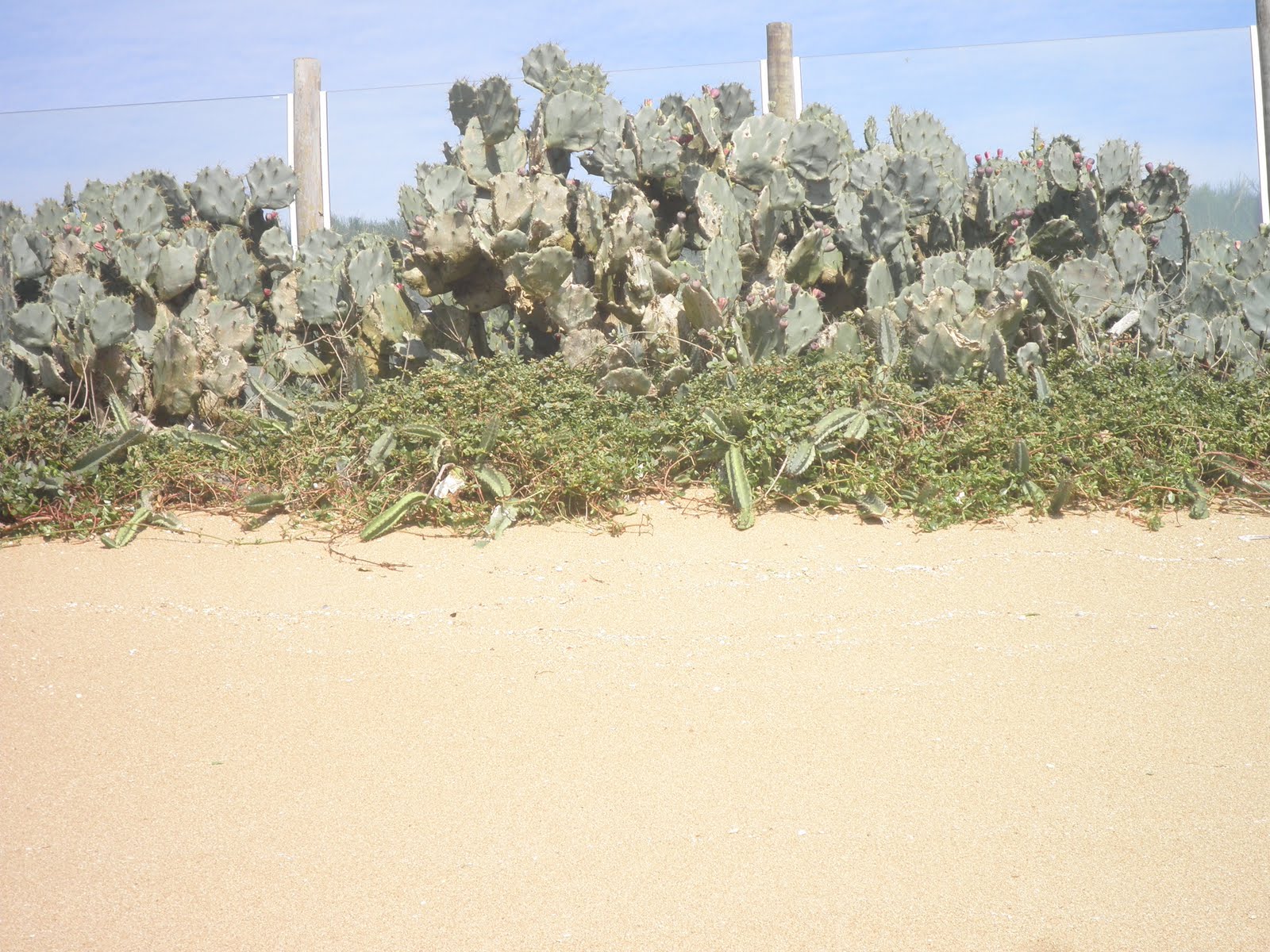
Usually when Mark and I walk on "our" beach of Manguinhos, we turn left towards the commerce and the restaurants. It just seems more natural to head in that direction, and it’s an efficient and ecological way to get our shopping done. We rarely turn right, since, well, there’s no there there. And in order to walk to the right at all, you need an extreme low tide. But if we do manage to make the effort, and make the right turn, we are abundantly rewarded. The right side of Manguinhos Beach is exactly what many people yearn for in a beach: empty, quiet, remote, teeming with unusual vegetation, and even a little spooky.


               Lots of empty expanse.


Then all of a sudden, there’s a small, discrete mangrove right smack dab in the middle of nothing.


Most Búzios beaches are lined with huge mansions. These houses are more modest, if not totally abandoned. They do have a certain charm, though.


 No sense calling this meeting to order . . .

I never had the honor of meeting this surprising and surprised visitor to Manguinhos Beach. But ever since he was spotted wandering down our beach, and photographed by a courageous person for the local paper, I keep my eyes wide open!


                            ***NOTE TO READERS***
I’m taking a little hiatus for a few weeks. See you all around mid-July!

03 June 2013

Batata Baroa


the divine batata baroa
If I were a complainer I could easily complain about not being able to find a real thick-skinned Idaho baking potato here in Brazil. Sometimes a person wants comfort food, and a baked stuffed potato on a chilly, windy night fits the bill. So when the mood strikes, we have to substitute what’s called batata inglesa (English potato), which is close, but no cigar. And if I were a complainer I could also complain about not being able to find real honest-to-goodness sweet potatoes, or yams. Oh, there is something called batata doce here, and that does literally mean sweet potato, but I’ve learned not to be fooled by the translation. Batata doce isn’t even a distant cousin to an American sweet potato, and it makes a lousy sweet potato pie. But I’m not a complainer. I have happily foresworn Idahos and given up yams because Brazil has something else, something so special, so delicious, so different, that a person just swoons when the aroma starts wafting from the kitchen. Brazil has batata baroa.

Batata baroa [ba-TA-ta ba-ROW-a] came rolling down the Andes, originally known by its Quechuan language name of arracacha, and took root all around South America under as many different names as there are ways to prepare it. It’s called Creole celery in Venezuela and Ecuador, Peruvian parsnip in Peru, and mandioquinha or batata baroa in Brazil. It’s sometimes referred to as "white carrot" in English, and pomme-de-terre céleri in French. But whatever it’s called, it’s got an extraordinary and distinct flavor. My first taste came many years ago via a spoonful of batata baroa soup on a cold, rainy night. I nearly fell off my chair. Wikipedia describes the flavor as "a delicate blend of celery, cabbage and roast chestnuts." I don’t think that does it justice, though it does hint at the nuttiness. To me it’s elegant, it’s subtle, it’s to die for.

You can roast batata baroa, or boil it, mash it or purée it. You can reduce it to a flour. You can make dumplings, gnocchi, soup, pastries, biscuits. You can make batata baroa chips. You could probably make a batata baroa knish, because anything you can do with a potato, you can do with a batata baroa. Here are our preferred preparations:

batata baroa soup, with leek and bacon


batata baroa gnocchi, with gorgonzola sauce


***QUESTION TO READERS*** As best I can tell, batata baroa is unavailable in the States. If I’m wrong, please let me know?

27 May 2013

You Call This First Aid?

...one, two, three....pause....one, two, three...
Remember those high school gym classes when some handsome volunteer fireman would come and show us how to administer emergency first aid? We learned CPR, mouth-to-mouth resuscitation (with lots of blushing and giggling, of course), how to tie a tourniquet, how to apply direct pressure and "elevate the area." And whether or not any of us have ever used these skills, we learned that running to help someone who’s hurt should always be your first response. In fact, it’s not for nothing that the new name for emergency personnel is First Responders. Thanks to the First Responders in Boston last month, the death toll was held to the initial three victims, because in an emergency you don’t have time to think, you just act. What else is first aid if not the aid you give first?

That’s why I’m obsessed by the absurdity of a new law in the State of São Paulo. This new law, promulgated in January 2013, prohibits police from assisting people injured in serious crimes. The police must keep civilians away from the victim, too. Everyone must stand back and wait for an ambulance to show up, while some poor guy bleeds to death, or dies of shock. I mean, think about this law in practical terms, particularly in a country where the ambulances come when they come. Last week in São Paulo a college student was walking home from evening classes when he was assaulted by an armed robber. The student immediately handed over his cell phone, but was shot anyway. Police arrived quickly, but the ambulance took 29 minutes. For 29 minutes the student lay on the cold, hard asphalt, bleeding and in pain, all the while surrounded by police and witnesses. Nobody was allowed even to staunch the blood. To me, this is not only absurd, but inhuman and criminal. (The following video is grainy, but shows the moment of the assault. The kid was finally taken to a hospital and to this day his condition remains serious, unsurprisingly.)


Folha de São Paulo's reader poll
What is the idea behind this nonsense? Well, the reasons are twofold. First, the São Paulo authorities say they want to offer quality care to the victim, the quality care that only trained medical personnel can provide. After all, the police might aggravate the injuries, right? And civilians, goodness knows what a mess they might make. So let’s all just wait — and wait, and wait — for the ambulance. The second reason given by the authorities is the need to ensure that no one interferes in a crime scene, neither police nor civilians. Really, I think people are watching too much CSI. I can’t imagine I’d prefer bleeding to death so as to preserve a crime scene. And I’ve found that I’m not alone in my outrage. The newspaper Folha de São Paulo conducted an online poll which found that 85% of the poll’s participants were against the new law.

Let’s not even mention that this new law contradicts Article 135 of the Brazilian Penal Code, which states that any failure to assist someone in need (omissão de socorro) is a crime. A classic damned-if-you-do-damned-if-you-don’t situation. All I can do is shake my head and plan to steer clear of São Paulo. I’m a product of my upbringing, and I’m used to laws that speak to a citizen’s duty to rescue, or duty to act, as well as Good Samaritan laws that protect those who offer emergency first aid. Remember Seinfeld? That show was syndicated in Brazil, and was wildly popular. Doesn’t anyone in São Paulo remember the show’s famous finale? The four protagonists find themselves with a few hours to kill in a small Massachusetts town, where they are arrested under a Good Samaritan law for failing to help someone in need, and are later sentenced to one year in prison. I think the authorities who promulgated the new "hands-off" law in São Paulo ought to watch this:


***NOTE***
Well, I was right, this new law sure is controversial. A week before I wrote this blogpost the law was stayed, but it was reinstated the next day, so I didn’t bother mentioning that detail. However, just days before the blog was set to publish, the law was stayed again, with the absurd contention, made by the Secretary of Public Safety, that the police were never actually prohibited from assisting. It was just a recommendation. I elected not to change the blog since in all likelihood some other authority will weigh in with more changes, leading to more confusion. That the law was even on the books for five months is, in my opinion, worth noting.

20 May 2013

Imagina Na Copa!


Hard to forget the many catchphrases of my youth, like Eh, what's up, Doc? and Heeeeere's Johnny, and the always sturdy Go ahead, make my day. And then there was one of my favorites, Where's the beef?, from Wendy's successful ad campaign to convince the public that Wendy's hamburgers had more meat in them than McDonald's or Burger King's. So popular were the commercials, and so infectious was the catchphrase — not to mention Clara Peller, the woman who delivered it — that even the normally dry and boring Walter Mondale got a big laugh when he used it in a 1984 democratic primary debate against an insubstantial Gary Hart.

There's a hilarious and wildly popular catchphrase making the rounds in Brazil these days. It's Imagina na Copa!, something like If you think this is bad now, just wait 'til the World Cup! At first people used it about traffic jams and chaos in the airports, but as the catchphrase got traction it was expanded to anything that might be bothering you: bad service in restaurants, black-outs, slow mail service, crowded beaches, surly taxi drivers, a bad hair day, in short, anything at all. I admit that I use it as often as I can. It's a terrific way to end a conversation without having to resolve anything, and to get a sure laugh to boot.


To get the full flavor of the catchphrase, watch this very funny YouTube video entitled "Shit Cariocas Say" — a parody of the video called "Shit New Yorkers Say" which, if you haven't yet had the pleasure, can be found at  http://www.youtube.com/watch?v=yRvJylbSg7o. The Brazilian version here, with English subtitles, is completely intelligible even if you've never been to Rio or met a carioca (a Rio native). During the course of the video, Imagina na Copa is used about seven times, and each time is funnier than the last.

The irony of this catchphrase is that the World Cup won't even be held in Brazil until 2014. Why are Brazilians trashing their future preparedness level when they have the FIFA Confederations Cup set to kick off in just a few short weeks? The number of Brazilian and foreign fans estimated to attend the Confederations Cup is around 950,000. That ought to test Brazil's mettle. And one month later Brazil will host World Youth Day, the triennial international event organized by the Catholic Church. Number of people expected? I've seen quotes of 2 million, 3 million and 4 million. Any way you look at it, that's a lot of bodies. As for the onslaught of visitors expected for the 2016 Summer Olympics, well, I haven't seen any official attendance estimates yet, but most people think things will be far worse during the Olympics than during the World Cup. Even so, it's Imagina na Copa that's caught everyone's imagination. It's simple, it's rhythmic, it's — well, you know, yada yada yada.


13 May 2013

Blog Updates

I know, dear readers, that many of you are sitting at the edge of your seat, wondering how some of our ongoing dramas have turned out. Well, let me not keep you in suspense. Here are a few blog updates:

Teaching Through Chocolate Chip Cookies (posted November 3, 2011)

Mark and I had really gotten psyched about our involvement with the after-school program known as COEDUC. The kids seemed to be excited too. But just as we were finalizing our schedule, drawing up "lesson plans" and deciding what dishes we would be preparing in the cooking classes, the owner of the property that COEDUC was renting decided to close the place down. The good people in charge of COEDUC have yet to find a new home. And we’re just biding our time.


Girl’s Night Out (posted November 10, 2011)

My weekly Girl’s Nights Out with Cristina are still going strong. But people have really cottoned on to us, so we’re doing our damnedest to keep our days and times and locations secret, and to stay under the radar . . . go ahead, see if you can pick us out in this picture.


Stupid Purchases (posted January 5, 2012)

I’m sure you’ll all be relieved to know that we found a way to get rid of the rusted, pitted and useless clothes dryer Mark and I bought during our first month in Brazil. We did the obvious and donated it to the washing machine repairman, who happily carted it away to dismantle for parts.


Gran Ciné Bardot (posted January 30, 2012)

After three years of loyal membership, Mark and I have abandoned the Videoteca of the Gran Ciné Bardot, at least for now. I won’t say we’d seen all of the 4,000 or so DVDs available, but we did feel a bit as if we were scraping the bottom of the barrel. And nowadays we’re able to stream incredible movies on YouTube. Which leads me to . . .

Watchin’ Movies (posted May 7, 2012)

We’ve now seen 1,735 movies here in Brazil, up from the 1,460 we’d seen at the time the blogpost was published. And thanks to YouTube’s archives we’ve added Egyptian, Armenian, Serbo-Croatian and Kenyan to the mix of nationalities.

A Smart City (posted September 3, 2012)

with blades . . .
. . . and now without
Remember when I reported that Búzios had been chosen to be the first Smart City in Latin America? I was skeptical then and I’m skeptical now. For one, we’ve been losing electricity a lot lately, and all it seems to take is a gust of wind. And a few months ago the large blades on the ultra-modern wind turbine in front of the Smart City showroom came crashing down. The company in charge of all this intelligence has yet to replace the blades. I’m happy to report, though, that nobody was hurt.


On Being Number Two (posted January 7, 2013)

In keeping with its habit of coming in second to the United States in almost every category, Brazil is now second only to the U.S. in number of fans on Dog TV’s Facebook page.


Moqueca de Peixe (posted April 1, 2013)

Our fabulous new clay pot for cooking moquecas exploded while we were preparing our moqueca number four. Everything was bubbling away nicely, and I was (thankfully) on the other side of the kitchen when I heard something that sounded like BB guns going off. Mark and our guest of that evening came running. I was okay, but the oven was now covered in bits and pieces of fish and green pepper and onion and tomato, not to mention shards of clay. Sometime much later that evening we all had a nice pizza down the street.


Paradise Lost
(posted April 22, 2013)

There’s been positive forward movement on this front. Citing an inability to break contracts already signed and paid for, our neighbor continued renting his house for large, loud parties. At the fourth such rental in a month, the renters did us the great favor of setting off fireworks throughout the night. This finally got neighbors who had not previously wanted to get involved very involved indeed. And this time it was neighbors other than us who called the police, who filed formal criminal complaints, and who called the owner in Europe. It appears that reason has prevailed, and there will be no more party rentals.

06 May 2013

Bakery 1 and Bakery 2

At the very bottom of our street is Bakery 1, Sonho de Búzios. It’s unpretentious, badly decorated, and poorly lit by ugly fluorescent lights. It sells beer, cigarettes and batteries alongside bakery products, offers a few precarious tables with uncomfortable plastic chairs, and always has an old TV with bad reception nattering away in the background. Bakery 1 sits behind a bus stop at an extremely busy intersection, and enjoys both a steady walk-in traffic and a solid stream of neighborhood regulars. When Mark and I first started using it, it was just to buy the Sunday edition of O Globo, Rio’s New York Times. And I wouldn’t stay longer than was needed to make the purchase. The place was just too creepy. But little by little, with the familiarity bred by routine, we started to stay for a cup of coffee, or some fresh-from-the-oven rolls heated up on the greasy grill and slathered with butter. We got to know Angela and Beto, the siblings who run the place, and whenever we feel like a simple breakfast you can be sure Bakery 1 is now our first choice.

cavacas
biscoitos champanhe
And we have discovered that they are not without some excellent baked goods. At 3:30 every day they put out about a dozen cheese baguettes, which have nothing to do with real baguettes, but are marvelously tasty, cheesy breads. Sometimes there’s nothing like a pão na chapa com queijo minas, a grilled cheese sandwich on a fresh-baked roll, and using a very good quality cheese from the state of Minas Gerais. And if you want to satisfy your sweet tooth, but don’t want something too sickly sweet, their cookies are perfect, particularly their cavaca, which balances its sweetness with herbs, and what they call biscoito champanhe, a personal favorite that reminds me of ladyfingers.

A mere five-minute walk from Sonho de Búzios is Bakery 2, Golden Bread. This is a bakery firmly set in the first world, straight out of Soho or the Left Bank. The decor is shabby chic demolition, the music low and jazzy, and the smells wafting from the kitchen guarantee high quality baguettes and croissants. This bakery even has its own Facebook page! No question but that Golden Bread has become the place to meet and greet, to see and be seen, to shake hands and do deals, or just to sit and pass the time with friends. Golden Bread is in the lovely Porto da Barra complex of restaurants and galleries and stores, and delivers consistent quality with lots of style. When I go there of an afternoon and order "the usual," it’s a sandwich of smoked salmon with a warmed caper sauce. Between my sandwich, a sinfully rich chocolate dessert and Billie Holiday on the sound system, Bakery 2 serves up my kind of heaven.

It has always been said that Búzios is a place where rich people go to play at being poor, and poor people go to play at being rich. This is indeed the irony of Bakery 1 and Bakery 2. While lots of newly upper-middle-class and rich folks flock to Golden Bread, perceiving it as the "rich people’s bakery," take a good look at the clientele of the hole-in-the-wall Sonho de Búzios. You may not know them, but some of those guys hanging out in their torn shirts and dirty sandals are multi-millionaires and billionaires. Not wanting to choose sides, Mark and I keep a foot in both bakeries.